


In 1986, nuclear fallout from the Chernobyl disaster threatened much of Europe. Patterns of wind and rain brought radioactive cesium to areas thousands of miles away from the meltdown. Fear blanketed the region faster than the cloud moved, as uncertainty around the magnitude of the risk spread. Would the radioactivity impact people’s health directly? Would it affect the land and the future crops grown in those regions?
In the UK, local scientists and agricultural authorities pushed a message to keep calm and carry on. They were unequivocal that there was nothing to fear and that the effects of the fallout would be negligible in the region. Farmers could proceed as normal with grazing their animals outside and selling their meat.
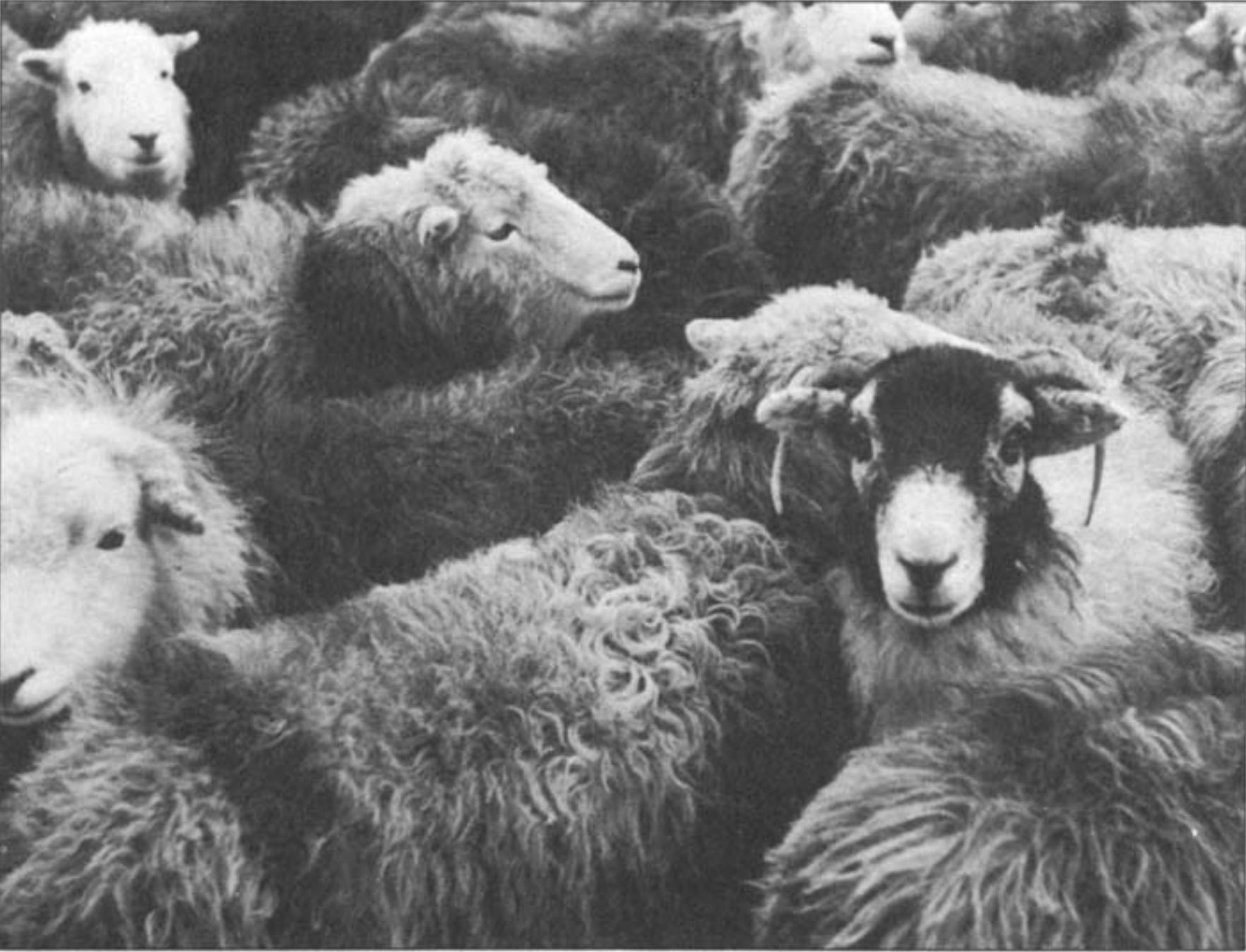
After six weeks, newer data showed elevated levels of cesium in animals in the Lake District of Northern England, where a large farming community raised sheep on the area’s grassy hills. A ban was placed on the movement and sale of animals from the region. Officials reassured everyone that this would be only temporary, just a three week pause to allow the radioactivity to subside before any meat was sold.
But as those weeks progressed, authorities again confidently changed their message, and the ban was extended indefinitely. The confident reassurances about the radioactivity being washed away were made based on previous analysis of alkaline soils; the peaty, acidic soils of the region didn’t chemically absorb the cesium in the same way, meaning that it could pass into the vegetation, and from there into the animals grazing the land.
This was catastrophic for the local economy of the region, which was heavily dependent on sheep farming as a way of life. A smaller region remained contaminated, restricted from grazing for years after.
This was the region where Brian Wynne, a British sociologist of science did his foundational research on the public understanding and misunderstanding of science. Through qualitative interviews with the farmers and local community, Wynne put together a picture of the fragility of public trust in science and scientific institutions, and what happens when that credibility breaks down.
In interviews, the farmers shared their beliefs in a growing conspiracy theory that the indefinite ban was actually the result of a different nuclear disaster that had occurred in the region decades earlier: a nuclear plant fire that had locally released plumes of radioactive smoke. While the farmers had taken those earlier issues in stride, overall valuing the economic benefit that the plant provided to the region and trusting the assurances of local authorities, the recent fallout made people question whether Chernobyl was just a convenient scapegoat for previous contamination in the area that had been hidden in a coverup implicating the company’s scientists and local authorities.
Wynne traces the community’s feelings of alienation, of the challenge to their social identities and their knowledge of the local ecology and practices of sheep husbandry, and the bitterness in response to what they saw as arrogance and overreach from the scientists, even after their predictions were proved wrong again and again. He contrasts these findings to the emerging consensus among the scientific community at the time, that mistrust and misinformation about scientific practices, risks, and institutions had their root in a lack of understanding and knowledge about science.
In the forty years since the disaster, we haven’t seemed to learn the lessons that Wynne concluded from this research. Our more recent scientific trust breakdowns are a remarkable echo: a faraway threat emerges, first to reassuring messages from public authorities, then news of a temporary lockdown, and then the opening up indefinitely postponed while livelihoods suffered and conspiracy theories bloomed. Or, more recently, organizations with no social and political accountability offer transformative technologies, while local communities situated near their infrastructure receive both economic benefit, ambiguous long-term risks, and confident reassurances, leading some to harbor conspiratorial beliefs and to push back through the limited channels available to them.
Today, like 40 years ago, scientists reach for familiar stories and coping strategies about the public understanding of science which cast the public as the problem. The public is anti-science, defensive, ignorant of the benefits we have reaped from science, and fundamentally risk averse and allergic to uncertainty—afraid because of their ignorance of statistics and scientific facts and therefore prone to conspiratorial thinking fueled by misinformation that fills the void.
In the mid 1980s, just before the Chernobyl disaster, the Royal Society had initiated an effort to advocate for improving the public understanding of science, informed by input from working scientists and literature from quantitative studies on public attitudes about science. Their report outlines how scientists see the public — lacking understanding, demanding certainty, and unable to draw the right conclusions from risk information — and calls for policies to improve science education and improved effort from scientists to communicate their findings and the impacts of basic science in more compelling and less condescending ways.
Wynne’s research begins with this context and asks: would that have made any difference to the farmers impacted by Chernobyl?
If they had studied more science in school, would the farmers have continued to trust the scientists even after their reassuring certainty was proven wrong again and again? If they understood the ways that scientists draw conclusions from data and how they understand risks, would it have changed the fact that they were potentially going to be forced to slaughter their flocks and lose their farms? If nuclear scientists had made more compelling television programs about cesium isotopes, would the situation have changed at all?
Wynne’s research found that the axioms of the “public understanding of science” — the public is ignorant of scientific facts and mistrustful of scientific uncertainty — didn’t hold true in the very real situations where scientific decision-making and risk assessment collided with people’s lives. On knowledge and facts: farmers were very willing to follow expert assessment on risks from the cesium isotopes, but balked at suggestions that conflicted with their own expertise in sheep farming. The scientists recommended that the farmers graze their animals in the valleys, to allow the radiation to subside on higher ground. But the farmers knew that the valley grass was in short supply, and that bringing their sheep there would lead to cascading disasters in future years if it was over-grazed in the short term. They didn’t have the same scientific expertise and apparatus required to measure cesium in the soil, but their knowledge also mattered for shaping the right response to the thread, and was ignored by over-confident scientists, undermining their overall credibility in the process. It was the scientists own misunderstanding of the farmers’ knowledge and points of view that broke down trust, not the farmers’ misunderstanding of the science.
Indeed, it was the scientists’ belief that the farmers demanded certainty and consensus in order to follow recommendations that hurt them the most. The situation was changing quickly, the facts were incomplete, and the realities of farming that the community lived with were always edged with uncertainty—weather and animals are not controllable and farming doesn’t follow a strict plan. The farmers were used to living with uncertainty; it was the scientists who brought certitude and confidence where it wasn’t yet warranted. This backfired spectacularly, and in interviews farmers shared sarcastic comments about the ways that the scientists offered their recommendations: ”We may be on the eve of a new age of enlightenment. When a scientist says he doesn’t know, perhaps there’s hope for the future!”
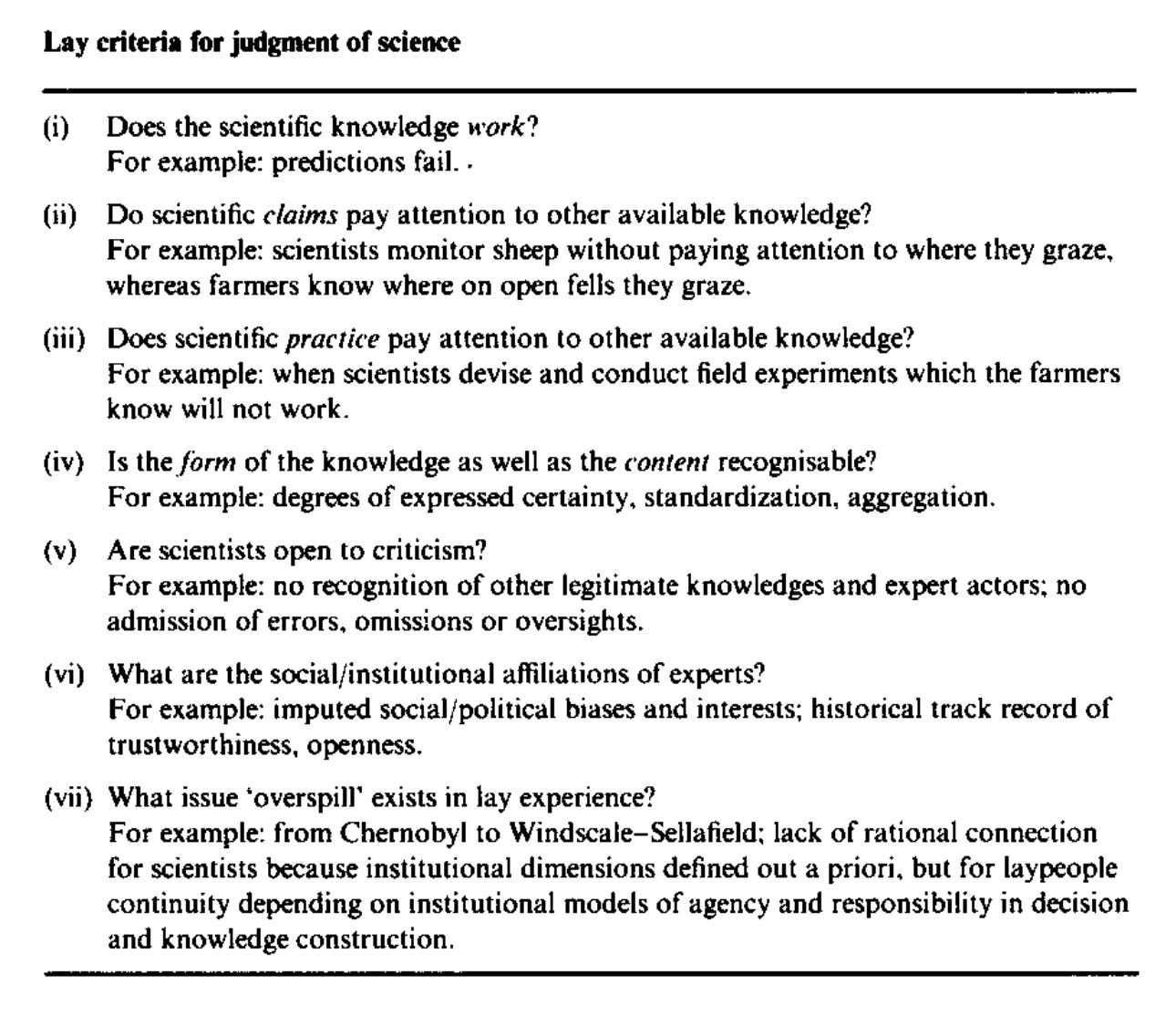
Wynne argues that to repair the broken trust between science and the public, we must first break down these myths and misunderstandings about the public that are—still! forty years later!—so pervasive in the scientific community. We have to look hard at ourselves and the assumptions we have about the publics we are communicating with, their social identities, values, and knowledge, and the ways that the problems themselves are framed. We have to break down the very frame that puts science in opposition with a non-scientific public to begin with. When people push back on scientific recommendations, they are rarely, if ever coming from a place that is fundamentally anti-science; they are challenging these tacit assumptions that cast their own social identities and lived experiences as lesser.
This is why it’s also a mistake to assume that the current breakdown in support for science funding in the US has its root cause in a more recent moment when scientists were personally more willing to speak up about their own identities and values, rather than remaining aloof as representatives of cold rationality and objective facts. What we learn from Wynne and others who have studied the way that science operates on the ground in situations where risks are weighed and trust is built or lost is that our social identities and commitments have always mattered in how science shapes decision-making.
Solving these issues won’t happen by communicating in a more engaging way about how basic research led to GLP-1s or whatever other valuable progress. The kind of reflexivity required—questioning our own assumptions and framings of science and the public, of problems and their solutions—as well as the vulnerability, accountability, and politics to address real risks and messy challenges is much harder than calling for better science media and education. But science is all about adjusting course based on new data, even if that course is hard.
Christina this is an incredible piece! You’ve put into words so many feelings that I’ve had the past few years but have been unable to really verbalize. Thank you for writing this.
The detail that stuck with me is that the farmers weren't anti-science at all. They trusted the scientists on the radiation, they just knew their own hills better than anyone flying in to measure them. That reframes the whole "public doesn't understand science" story.
What's uncomfortable is how the same reflex shows up inside science too, where we tend to blame poor communication for things that might actually be the data pushing back. Owning that is a lot harder than making another explainer.