


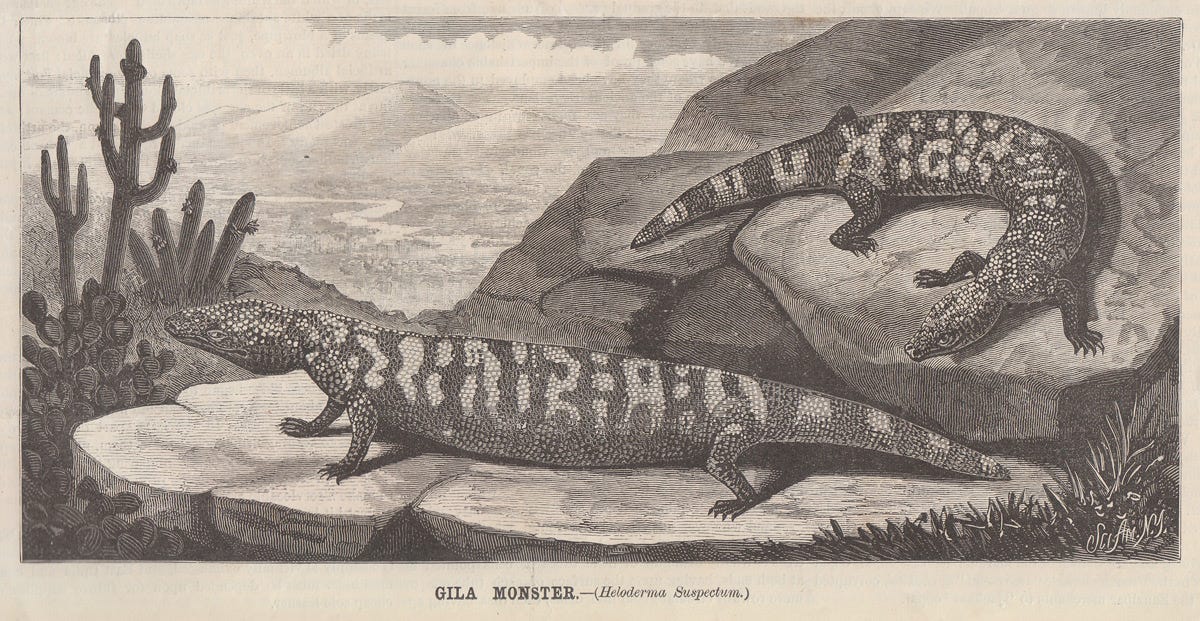
Recently I’ve been hearing my science friends telling the same story over and over.
Galvanized by the catastrophic cuts to American science, they reach for stories to show the value of basic research, to help us imagine the innovations that we’ll be missing out on if we cut all the stuff that a lawmaker or DOGE staffer could consider silly or useless. Even Ozempic, they note, started out as curiosity driven research into gila monster saliva, the kind of thing that would be deemed “silly” today!
It’s a beautiful story. Intrepid explorers simply seeking to understand the natural world, exploring the spit of a funny desert creature, an aha moment, a trillion-dollar molecule.
Unfortunately it’s not quite true.
If you google “discovery of ozempic” you’ll find that the story is much more applied than “studying Gila monster saliva” makes it sound.
The Gila monster peptides that provided the first proof of concept for what would become today’s boom of GLP-1 drugs were discovered by a team of endocrinologists in the early 90s working at the Veterans Affairs Medical Center in the Bronx.
Their papers cite the discovery of other peptide hormones in Gila monster venom that stimulate the production of digestive enzymes from pancreatic cells.
Those papers in turn cite a 1981 paper from NIH researchers systematically exploring non-mammalian venoms specifically for their abilities to stimulate pancreatic cells, finding that Gila monster in particular holds peptides that stimulate the pancreas to secrete enzymes that control glucose metabolism and satiety. And that research was itself spurred by observations of various venomous bites causing pancreatitis in humans, and that Gila monsters wait for exceptionally long times between meals, suggesting that their metabolism has unique features we could learn from.
These researchers weren’t just “studying Gila monster saliva” for curiosity’s sake, they were hunting for bioactive peptides that could become medicines. They had a story that connected their search to existing knowledge of glucagon-like peptides and their role in metabolism, a story that directed their curiosity in a way that blurred the boundary of basic and applied.
For all our talk of curiosity driven research, the way this myth persists shows a shocking lack of curiosity about how innovations actually happen.
It’s understandable in this very destabilizing time that we reach for these stories. And it makes sense to challenge with counterexamples the ways that bad faith arguments for limiting research funding often take advantage of how absurd some research can sound when taken out of context. But what makes for a punchy tweet can also cost us in the long run.
This myth is easy to bust with a simple google search, but this meme reveals other, much more insidious myths about how science works and how we talk about it.
One is the myth of the basic/applied divide itself and what it takes for science to translate to innovation: that if enough curious scientists collect enough data over time, someone (or, increasingly, some AI) down the line will eventually figure out how to do something useful with it. But the researchers studying Gila monster venom weren’t just characterizing venom for the sake of pure knowledge creation, they were following a thread that connected researchers and clinicians working to treat venomous bites and metabolic disorders. It was preliminary and exploratory, it was perhaps weird, but it was driven by a very applied story. When we strip that story away from how we describe this history, we risk stripping out the very real process of how new discoveries happen.
There’s a second myth that follows the first: that demands for accountability or limits to research spending come when the populace and their representatives are simply unaware of specific examples of how scientific research is connected to innovations that they enjoy. That if we can just tell them about the applications in a more engaging way, they’ll continue to support more and more of that basic work upstream.
This myth is the foundation of a social contract for science that has held, more or less, since Vannevar Bush wrote The Endless Frontier in 1945—the idea that society funds researchers to explore freely, and trusts that the returns will come. And for decades, the story-telling strategy that follows from it has worked well enough. NIH budgets survived repeated political attacks and grew larger. Basic research was protected. The Gila monster stories, and others like them, seemed to do their job.
But that contract has been shaken repeatedly by crises of reproducibility and of confidence, moments where doubling down on our standard scicomm playbook hurts much more than it helps. What we’re seeing now may be its collapse rather than just another budget fight. We’ve been returning to the same playbook again and again; now it’s time for new experiments and challenging our old assumptions and myths.
Our myths persist because they validate our beliefs and our desires, they are the story we tell ourselves about how the world should work. But discovery isn’t a story of pure research entirely disconnected from applied development. It’s also not something that can happen predictably when it is forced or on the clock or conforming strictly to revenue expectations at each step of the way—it does require some play and exploration of things that can indeed seem weird or turn out to not work. In my own time in academia I spent time studying the cell-killing properties of molecules found in sea sponges, exploring the microbiology of toe cheese, and trying to make animals photosynthetic. I’ve gone down dead ends and weird rabbit holes, and made time for play and new connections to find new stories and catalyze new ideas. I want to share the deeper story of Gila monster venom precisely because I value both the silliness and the focus of applied product development that comes from exploring weird biology.
Just as every weird organism does potentially have an interesting and useful adaptation for us to learn from, so too does every story of a discovery have so much more richness to it that can tell us so much more about how science works. We just have to be curious enough to look deeper, to see the ways our stories shape our science and the trajectories of innovation. The work it will take to build a new social contract for science demands it.
I think the usefulness of the Gila monster story is that research that *looks* foolish at a distance often turns out to be useful. When senators get up and say "Can you believe we're paying people to do [stupid sounding thing]??" they are often describing research that looks a lot like characterizing the metabolism of Gila monsters. They are not picking on "curiosity-driven" projects, because, as far as I can tell, no government grant has ever been awarded for one. They are instead picking on projects that sound impractical when you don't fully understand the goals of those projects. The point of telling people about Gila monsters is showing that if you want effective weight loss drugs, you might have to do things that don't look much like developing a weight loss drug.
The retrospective tidiness of discovery stories is a pet peeve of mine too, because it launders all the luck and dead ends out of the record. GLP-1 is a perfect example of a payoff nobody could have written into a grant proposal. How do you think funders should weigh that, given they cannot fund every piece of curiosity-driven work and still have to choose?